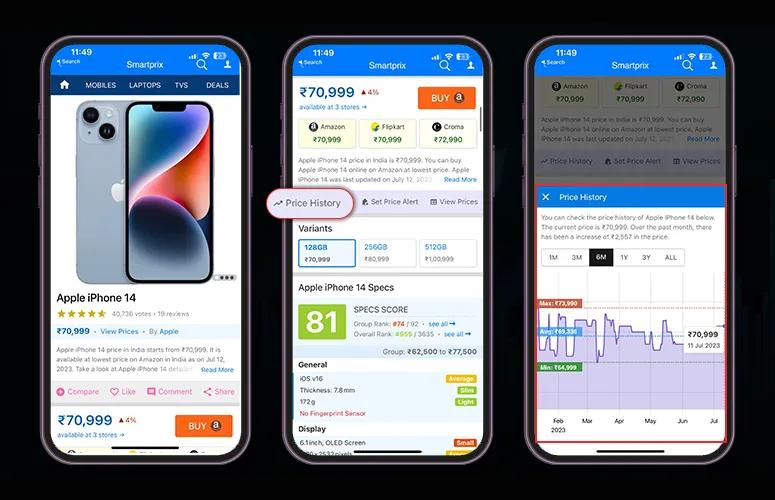
A phone advertised with a 25% discount can look like a great deal. However, the number displayed on the screen does not reveal whether the phone is unusually affordable, whether it recently sold for less, or whether another retailer has a better offer.
Note: Dollar amounts in this article are illustrative examples or budget targets, not live Amazon prices. Prices change often, so check the current price on Amazon before you buy.
Before buying, investigate the price to determine whether the discount represents genuine savings. A few minutes of research can help you distinguish a worthwhile deal from a routine promotion presented as a limited-time offer.
This is especially useful when purchasing expensive electronics. Understanding a phone’s price history can also help you budget for accessories such as wireless earbuds, a smartwatch, or a phone charger.
Start With the Price, Not the Discount Tag
Imagine a phone originally listed at $699 with a current sale price of $549. The promotion advertises a saving of $150, which sounds attractive.
But consider a few important questions:
- Was the phone regularly selling for $549 before the promotion?
- Has it previously dropped below that price during other sales?
- Is the same phone available for less from another reputable seller?
If the phone usually sells for around $550, the advertised reduction from $699 may not represent an exceptional bargain. However, if its typical selling price has consistently been higher, the current offer could provide meaningful savings.
The key difference is between a discount calculated from a reference price and a discount compared with what customers typically pay.
Check the Phone’s Price History
Price history shows how a product’s listed price has changed over time. Rather than judging a deal by its current price alone, you can compare it with previous offers.
On Amazon, look for the Price history option on the product listing when available. Amazon’s shopping tools may also provide information about an item’s previous pricing. The available history period and interface can vary.
You can start with Amazon’s official guide to checking price history.
For additional historical pricing information, consider these independent tracking services:
- Keepa provides Amazon price-history charts and price-drop alerts.
- CamelCamelCamel lets shoppers review Amazon price history and set price-watch alerts.
A price chart can reveal whether the current offer falls within the phone’s usual price range or represents a comparatively low price for the period being tracked.
Keep in mind that a 30-day low is not necessarily a 365-day low, and a one-year low does not automatically represent the lowest price ever recorded.
Look for Patterns in Previous Sales
A single sale price is only a snapshot. Looking at prices over several weeks or months provides more context.
When reviewing a price-history chart, consider how the price changes over time. Does it usually remain within a narrow range? Does it fall during major shopping events? Does it repeatedly increase before returning to the same lower price?
Consider this hypothetical example:
| Price observation | Amount |
|---|---|
| Previously typical selling price | $600 |
| Price before the sale | $650 |
| Current listing price | $599 |
| Lowest price during the period checked | $529 |
The current listing advertises a $51 reduction from the immediately preceding price. However, the phone has previously sold for $529, making today’s price $70 higher than the recorded low.
That does not automatically make the current promotion misleading or a poor deal. The lower price may have been available briefly or in limited quantities. The current offer might be easier to obtain. Nevertheless, the historical data helps you evaluate the difference.
These figures are illustrative and do not represent the actual price history of a specific phone.
Make Sure You’re Comparing the Same Phone
Phone prices are not always directly comparable. Listings may differ in storage capacity, carrier compatibility, condition, or included accessories.
Before comparing prices, check the following details:
- Model: Confirm that both listings are for the same phone generation and model.
- Storage capacity: Compare the same storage configuration.
- Condition: Keep new, used, and refurbished devices separate.
- Seller: Check who is selling the phone and whether the seller is reputable.
- Unlocked status: Compare unlocked phones with other unlocked phones.
- Promotional conditions: Check whether the deal requires a coupon, membership, trade-in, or other special condition.
A lower advertised price is useful only when the product and purchase conditions match what you actually want.
Consider the Final Checkout Price
The advertised price may not be the amount you ultimately pay.
Some promotions require you to select a coupon, provide a qualifying trade-in, or meet other conditions. Carrier offers may spread savings across monthly bill credits instead of reducing the upfront purchase price.
Check the amount you must pay and the conditions attached to the offer. Then compare that figure with other listings for the same phone configuration.
For example, a phone priced at $549 without special conditions may be more practical than one advertised at $499 that requires a trade-in you do not have. The second offer may still be attractive to shoppers who qualify, but it is not automatically the better choice for everyone.
Shipping charges, applicable taxes, and return policies can also affect the overall value of a purchase.
Compare Prices Across Multiple Retailers
Price history helps you determine whether a phone is inexpensive compared with its own previous prices. It does not establish that the phone is currently cheaper on Amazon than everywhere else.
Check at least one other reputable retailer offering the same phone. Compare the model, storage capacity, condition, seller, and purchase terms directly.
For example, if you are considering the Apple iPhone 17e on Amazon.com, use the listing to examine the exact configuration, current price, seller, and available historical pricing information rather than relying only on a search-result price.
The same approach works for Samsung Galaxy smartphones and Google Pixel smartphones.
Prices and availability can change, so verify each offer when you are ready to buy.
Don’t Forget About Accessories
When budgeting for a new phone, consider whether you need accessories immediately or can purchase them later. This can help prevent the handset from consuming your entire budget.
Related products worth comparing on Amazon.com include:
Each accessory has its own pricing patterns and promotional offers. A bundle is not automatically better value simply because it is advertised as a special deal. Compare the individual prices and purchase only the items you need.
Set a Target Price Before the Sale
Deciding what you are willing to pay before a promotion begins can help you avoid impulse purchases.
Choose a target price based on three factors:
- The phone’s historical price range.
- Your available budget.
- The value you expect to receive from the device.
Once you have a target, use the product listing or a price-tracking service to monitor changes. Tools such as Keepa and CamelCamelCamel offer price-watch features where supported.
When an alert arrives, check the offer again. Confirm that the seller, phone configuration, and promotional conditions are still acceptable.
You do not necessarily have to wait for the lowest recorded price. If the phone meets your needs and the current offer fits your budget, buying slightly above a brief historical low may still be reasonable.
When Is a Phone Price Drop Worth Taking?
A lower price is only one part of a good purchase. The phone must also suit your needs.
Consider buying when:
- The current price compares favorably with the relevant historical period.
- The listing matches your preferred model and configuration.
- The seller is reputable and the return policy is acceptable.
- The purchase fits your budget without relying solely on the advertised discount.
Consider waiting when:
- The price is close to its usual range despite a large advertised discount.
- The phone has repeatedly sold for less during the period you checked.
- You do not need a replacement immediately and can comfortably wait.
- The seller or promotional conditions are unclear.
Price charts cannot predict exactly when another discount will arrive. They can, however, provide useful evidence for deciding whether to buy now or wait.
Final Thoughts
Checking whether a phone price drop represents genuine savings requires more than looking at a large discount percentage.
Review the phone’s price history, compare the exact configuration, check the final checkout price, and look at offers from other reputable retailers. If the deal still looks attractive after these checks, you can make a more informed purchase.
A sale tag creates urgency. A little research helps you decide whether the deal is actually worth taking.
Amazon Affiliate Disclosure: As an Amazon Associate, I earn from qualifying purchases. If you click on an Amazon.com link in this article and make a purchase, I may earn a commission at no additional cost to you.