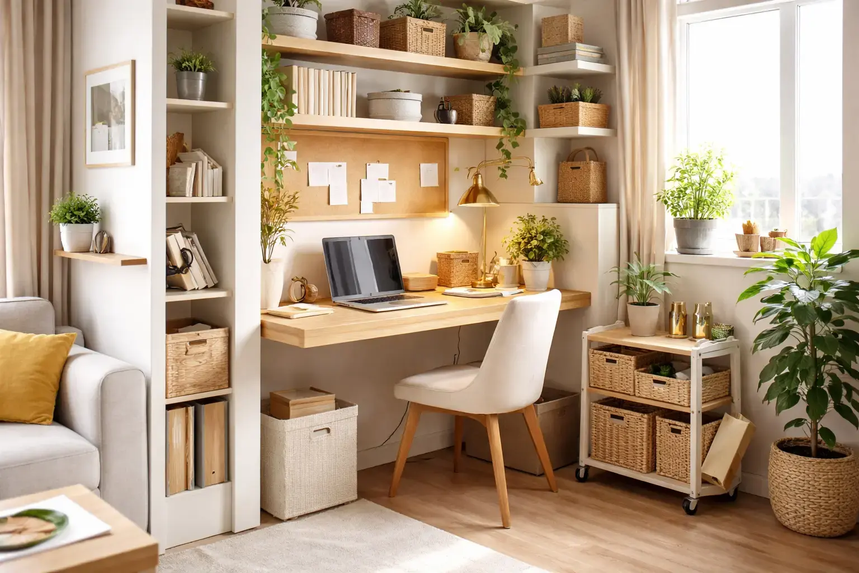
A small home office can quickly become cluttered with notebooks, chargers, paperwork, office supplies, and work equipment. The challenge is not simply finding more storage but creating an organized workspace where everything has a designated place without making the room feel cramped.
From maximizing wall space to organizing cables and choosing multifunctional furniture, the right storage solutions can make even a small home office more functional and comfortable.
1. Make the Most of Empty Walls with Floating Shelves
When floor space is limited, floating shelves provide additional storage without occupying valuable room on the floor. They are useful for keeping books, storage boxes, stationery, and other office essentials organized.
You can explore floating wall shelves on Amazon.com to find options that fit your workspace.
Place frequently used items on lower shelves and less frequently used supplies on higher levels. Matching storage boxes and baskets can also create a cleaner, more consistent appearance.
What to consider when choosing floating shelves:
- Measure the available wall space before purchasing shelves.
- Choose mounting hardware suitable for the wall material and expected weight.
- Use storage baskets and boxes to keep small items organized.
- Leave some empty space for easier access and future storage needs.
Floating shelves are particularly useful in narrow rooms, compact offices, and workspaces positioned against a wall.
2. Choose a Desk with Built-In Storage Drawers
A desk with built-in drawers can reduce clutter by providing dedicated storage for everyday office essentials. Instead of placing additional storage boxes around the workspace, you can keep most supplies within the desk itself.
Browse office desks with drawers on Amazon.com to compare compact options for smaller rooms.
Shallow drawers are suitable for pens, sticky notes, adapters, and small accessories, while deeper drawers can accommodate notebooks, documents, and other equipment.
Before purchasing a desk, measure the available floor space carefully. Make sure there is enough room for the chair to move comfortably and for you to sit and stand without difficulty.
Consider the items you use most often when selecting a desk. A simple desk with practical drawers may be more useful than a larger model with features that take up unnecessary space.
3. Maximize the Space Beneath Your Desk
The area underneath a desk often becomes wasted space or a place where miscellaneous items accumulate. A compact rolling drawer or storage cabinet can turn this area into a useful storage zone.
Explore under-desk storage drawers and rolling cabinets to find a unit that fits beneath your desk.
Rolling storage units can hold printer paper, stationery, notebooks, and documents that do not need to remain on the desktop. They can also be moved when cleaning or rearranging the office.
Before purchasing an under-desk cabinet, check its height, width, and depth against the available space. Make sure it does not interfere with your legs, chair movement, or access to electrical outlets.
The best approach is to store items beneath the desk that you need occasionally rather than equipment that must remain within constant reach.
4. Organize Paperwork with a Vertical File Holder
Paperwork can occupy a surprising amount of desk space, particularly when several projects are being managed simultaneously. A vertical file holder helps organize documents without creating large horizontal stacks.
Check out vertical file holders and desktop document organizers on Amazon.com.
Create separate categories for documents such as:
- Work in progress
- Reference materials
- Documents awaiting review
- Papers that need filing
Choose a file holder that fits the volume and size of your documents. If you regularly handle confidential paperwork, use a lockable cabinet for sensitive records and follow any applicable document-retention and data-protection requirements.
Keeping active paperwork separate from archived documents makes it easier to locate important information while maintaining a tidy workspace.
5. Use a Pegboard to Store Everyday Equipment
A pegboard provides flexible storage for small office accessories and frequently used tools. Depending on its design and weight capacity, it can accommodate hooks, small baskets, scissors, headphones, and other lightweight equipment.
Browse office pegboards and pegboard accessories to find a suitable setup for your workspace.
Unlike fixed shelves, pegboards allow you to rearrange hooks and accessories whenever your storage needs change.
For the best results, group similar items together and position frequently used accessories at a convenient height. Always check the board’s mounting requirements and the weight limits of individual hooks before adding equipment.
Pegboards are especially useful for people who work with multiple gadgets, creative tools, or accessories that would otherwise occupy the desk.
6. Make Use of the Back of an Office Door
The back of a door can provide additional storage when there is little room for cabinets or shelving. An over-the-door organizer with pockets can hold envelopes, notebooks, stationery, cables, and other lightweight supplies.
Explore over-the-door organizers on Amazon.com for options that make use of otherwise unused space.
This solution works particularly well in bedroom offices, converted closets, and shared living spaces.
Door organizers are also useful for temporary workspaces because they can often be removed when the room needs to serve another purpose.
Before installing one, make sure the organizer does not prevent the door from opening or closing properly. Avoid placing heavy electronics or equipment in pockets that are not designed to support their weight.
7. Add a Narrow Rolling Cart for Extra Storage
A narrow rolling cart offers flexible storage without permanently occupying a large section of the room. It can be placed beside a desk, moved closer during work, or tucked against a wall when not needed.
Find narrow rolling storage carts on Amazon.com in different sizes and configurations.
Use the top shelf for frequently accessed supplies, the middle shelf for active projects, and the bottom shelf for backup equipment or heavier items within the cart’s rated capacity.
Check the cart’s overall dimensions, including its wheels, before buying it. The distance between shelves should also accommodate the items you intend to store.
A compact cart is often a practical choice for narrow offices where a conventional filing cabinet would leave too little room to move comfortably.
8. Store Spare Supplies in a Shared Closet
Not every office item needs to remain near the desk. If your workspace shares a room with a bedroom or living area, using an existing closet for backup supplies can free up valuable space.
Browse clear storage bins and stackable closet organizers to find options for organizing office supplies.
Labeled boxes and transparent storage bins make it easier to identify items without opening every container. Keep regularly used supplies on accessible shelves and reserve higher shelves for lightweight items that are needed less frequently.
Heavier containers should be placed on sturdy lower shelves, provided they can be lifted safely. Leave enough room to remove boxes without having to rearrange the entire closet.
This approach separates everyday essentials from backup supplies and helps prevent the desk from becoming a storage area for items used only occasionally.
9. Control Cable Clutter with Dedicated Organizers
Chargers, power leads, headphones, and computer cables can quickly make a small office look untidy. Cable management accessories help keep these items organized while reducing clutter around the desk.
Consider these useful options:
- Cable clips: Shop cable clips on Amazon.com to keep frequently used cords in place along the edge of a desk.
- Under-desk cable trays: Browse under-desk cable management trays to hold power strips and route cables away from the floor.
- Cable storage boxes: Find cable management boxes to conceal compatible power strips and excess cable lengths.
- Small storage pouches: Explore cable organizer pouches to keep spare adapters, headphones, and charging cables together.
- Cable labels: Shop cable identification labels to identify connections without having to trace every wire.
Choose cable organizers that accommodate your equipment and allow adequate ventilation around electrical devices. Keep cables away from walking paths and avoid overloading power strips.
A simple cable-management system can make the workspace easier to clean and help prevent cords from becoming tangled.
10. Choose Multifunctional Storage Furniture
Multifunctional furniture is particularly valuable in small home offices because it combines several uses in one piece. This can reduce the number of separate items needed to furnish the room.
Consider options such as:
- Desks with integrated shelving or drawers
- Compact bookcases with enclosed storage
- Fold-down desks with shelves
- Storage benches for multipurpose rooms
- Wall-mounted desks for small spaces
Choose furniture according to the actual needs of your workspace rather than the number of features it offers. A large piece with several compartments may still be unsuitable if it restricts movement or makes the room feel crowded.
For a home office that doubles as a bedroom or living room, enclosed storage can also help conceal equipment when the workspace is not in use.
What Storage Solution Is Best for a Small Home Office?
The best storage solution depends on the type of clutter you need to manage. The following comparison highlights the advantages of common options.
| Storage solution | Ideal for | Space-saving advantage |
|---|---|---|
| Floating shelves | Books and supplies | Uses wall space |
| Desk with drawers | Everyday office essentials | Combines furniture and storage |
| Under-desk drawers | Accessories and documents | Uses otherwise empty space |
| Vertical file holders | Active paperwork | Reduces desktop clutter |
| Pegboards | Gadgets and tools | Keeps accessories off the desk |
| Over-the-door organizers | Lightweight supplies | Uses an overlooked surface |
| Rolling carts | Mixed office equipment | Moves wherever needed |
| Closet storage bins | Backup supplies and archives | Keeps rarely used items out of sight |
| Cable organizers | Wires and adapters | Reduces cable clutter |
| Multifunctional furniture | Shared or multipurpose rooms | Combines several uses |
A Simple Storage Plan for a Small Home Office
Organizing a small office does not require purchasing every storage accessory at once. A step-by-step plan can help you identify the most useful changes before spending money on new furniture.
Step 1: Clear the desk. Remove items that are no longer needed and separate everyday essentials from supplies that can be stored elsewhere.
Step 2: Sort everything into categories. Group stationery, paperwork, electronic accessories, work equipment, and backup supplies so you can determine the type of storage each category requires.
Step 3: Identify unused space. Check the walls, the area beneath the desk, the back of the door, and any available closet space before buying additional furniture.
Step 4: Assign a place for each category. Keep frequently used items within easy reach, active paperwork in a file holder, and rarely used supplies in labeled boxes or a closet.
Step 5: Measure before purchasing. Check the dimensions of the room, desk, chair, and proposed storage furniture. Make sure drawers can open fully and doors can move without obstruction.
Step 6: Review the arrangement after a week. Identify the items that still accumulate on the desk and relocate them to a more convenient storage area.
Following this process helps you avoid buying unnecessary furniture and ensures that each storage solution addresses a specific problem.
Final Thoughts
A small home office does not need bulky cabinets or expensive furniture to become organized. Practical changes such as adding floating shelves, choosing a desk with drawers, using vertical file holders, and managing cables can make a noticeable difference without sacrificing valuable floor space.
The most effective solution depends on what causes the clutter. If paperwork dominates the desk, vertical file storage may be the best starting point. If cables and small accessories are the main problem, drawers and cable organizers can help. If the office shares space with another room, multifunctional furniture and closet storage may provide the greatest benefit.
By measuring the available space, prioritizing everyday essentials, and selecting storage according to your actual needs, you can create a home office that remains comfortable, functional, and easy to maintain.
Amazon Affiliate Disclosure: As an Amazon Associate, I earn from qualifying purchases. If you purchase products through links to Amazon.com on this page, I may earn a commission at no additional cost to you.