Living in an apartment presents unique security challenges. You might have a sturdy front door but share access to a hallway with other residents. Packages may be left outside your unit, windows might face a busy street, and building management may limit the modifications you can make to your property.
Installing a complete alarm system or undertaking major home improvement projects is not always practical for renters. Fortunately, several security accessories can help you monitor entry points, reinforce doors, and receive alerts about unexpected activity without making permanent changes.
The goal is to choose accessories that fit your budget, respect your lease, and provide useful protection without inconveniencing your neighbors. Here are the home security accessories worth considering for apartment living.
1. Begin Securing Your Entrance With a Portable Door Security Bar
The front entrance is a natural starting point when evaluating apartment security. A portable door security bar provides an additional layer of resistance without requiring you to replace the existing lock or modify the door frame.
Most models feature an adjustable metal bar that braces against the floor and the underside of a door handle or another suitable contact point. Some are designed for hinged doors, while others are intended for sliding doors.
This accessory can be particularly useful for renters because it can usually be installed and removed as needed. It may also be convenient when moving between apartments.
Before purchasing one, measure the available space and confirm that the product is compatible with your door and flooring. Door clearance, surface materials, and handle placement can affect its stability. Always follow the manufacturer’s installation instructions.
Browse portable door security bars on Amazon.com.
2. Use Door and Window Alarms to Detect Unexpected Entry
A lock helps secure an entrance, but it does not necessarily notify you when someone opens a door or window. Door and window alarms can provide an additional warning when an entry point is opened.
Many models use two small magnetic components positioned close together on a door or window frame. When the components separate, the alarm sounds. Some connected models can also send notifications to a smartphone.
These alarms can be useful for:
- Ground-floor apartments with accessible windows.
- Sliding balcony doors.
- Bedrooms with additional entry points.
- Rental properties where permanent installations are restricted.
Start by placing alarms on the main entrance and any easily accessible windows. You can expand coverage if needed.
Check the product specifications for siren volume, battery requirements, mounting instructions, and whether a separate receiver or hub is necessary. In buildings with thin walls, adjustable sound settings may help reduce disturbances for neighbors.
Explore door and window alarms on Amazon.com.
3. Monitor Your Living Space With an Indoor Security Camera
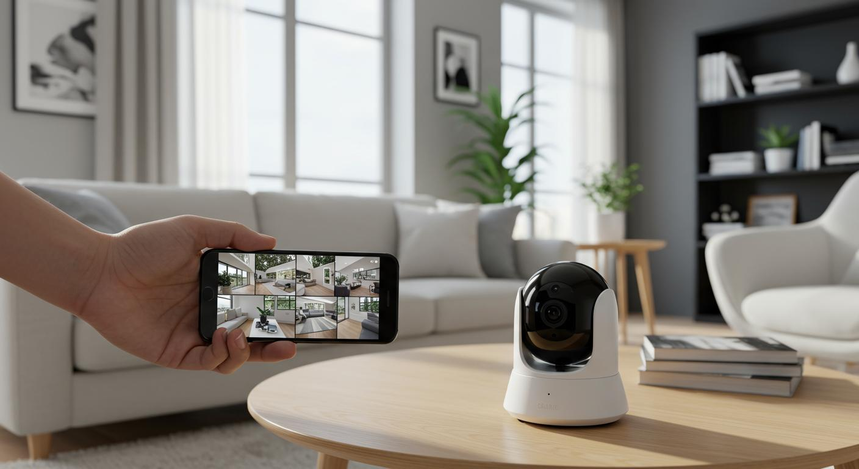
An indoor security camera allows you to check what is happening inside your apartment while you are away. Depending on the model, features may include live viewing, motion notifications, night vision, video recording, and two-way audio.
You do not necessarily need several cameras to improve visibility. In a studio or one-bedroom apartment, a single camera positioned to view your own entrance from inside may provide useful coverage.
Consider the following features when comparing models:
- Privacy mode: Allows you to disable recording or viewing when you are home.
- Storage options: Check whether footage requires a cloud subscription or can be saved locally.
- Motion detection: Sends alerts when movement is detected within the selected area.
- Two-way audio: Lets you communicate with visitors when supported.
- Flexible mounting: Makes positioning easier without drilling permanent holes.
Before buying, review the camera’s privacy settings, data retention policies, and third-party sharing practices. Enable two-factor authentication when available and use a strong, unique password.
Keep the camera focused on your own living space. Avoid recording other tenants’ homes, shared hallways, or areas where people reasonably expect privacy. Check your building’s policies before installing recording equipment.
Compare indoor security cameras on Amazon.com.
4. Reinforce Vulnerable Windows With Supplemental Locks
Windows are often overlooked when apartment security plans focus primarily on the front door. However, ground-floor units, apartments near accessible rooftops, and homes with reachable balconies may have additional entry points to consider.
A supplemental window lock can help restrict how far a window opens. Depending on the design, it may use a clamp, a track-mounted mechanism, or another locking method.
Compatibility is essential. A product designed for a horizontal sliding window may not work with a vertical sash window, and some locks are unsuitable for particular frame materials.
Security should never interfere with emergency escape. Make sure any additional lock allows occupants to exit safely and complies with applicable fire-safety requirements.
Renters may prefer removable options, although adhesive-mounted products can still damage paint or finishes. Check the manufacturer’s removal instructions and your lease before installation.
Find sliding window locks on Amazon.com.
5. Consider a Video Doorbell or Visitor Alert System
Packages and unexpected visitors can create challenges for apartment residents. You may be away when a delivery arrives, or you may not know who approached your door until you return home.
A video doorbell can provide visitor alerts, live video, and two-way communication. However, apartment buildings may restrict modifications to existing doorbells or prohibit cameras in shared hallways.
If installation is permitted, choose a model that works with your existing wiring or supports battery operation. Check whether video storage requires a subscription and whether the device can be installed without damaging the door frame.
If cameras are not permitted in common areas, consider alternatives such as an indoor camera facing your own entrance, delivery notifications, or a building-approved package locker.
Never assume a device is allowed simply because it uses a removable mount. Building rules may also cover surveillance, recording, and the appearance of shared spaces.
Compare video doorbells on Amazon.com.
6. Improve Visibility With Motion-Activated Lighting
A motion-activated light can make it easier to see your surroundings when entering your apartment at night. It may be useful near an interior entrance, inside a private balcony area, or in another dark part of your home.
Battery-powered lights are convenient for many renters because they do not require permanent electrical wiring. Depending on the design, they may attach with adhesive, use magnetic mounts, or stand on a shelf.
Choose a light with suitable brightness and a detection range that fits the space. Avoid positioning it where it shines into neighboring apartments or repeatedly activates because of movement in a shared hallway.
Check whether the product is rated for indoor or outdoor use, depending on where you intend to place it. Review your lease and building policies before mounting anything in a shared area.
Browse battery-powered motion sensor lights on Amazon.com.
7. Explore a Smart Lock Compatible With Your Existing Door
Smart locks can simplify access management by allowing compatible doors to be unlocked using an app, keypad, or temporary access code. Some retrofit models attach to the inside of an existing deadbolt, leaving the exterior hardware unchanged.
However, not every smart lock is suitable for apartment living. Before purchasing one, check the deadbolt type, door clearance, installation requirements, and compatibility with your existing locking mechanism.
A smart lock may be useful if you regularly coordinate access for trusted visitors or want to check whether your door is locked remotely. Nevertheless, it should not be treated as a substitute for an appropriate physical lock.
Consider battery life, backup access methods, connectivity requirements, and whether the device needs a separate hub. Obtain permission from your landlord or property manager when necessary, and never disable required locks or interfere with emergency exits.
Explore retrofit smart locks for existing deadbolts on Amazon.com.
8. Add Water Leak Detectors and Maintain Safety Alarms
Apartment security also includes protecting your home from household emergencies. A small leak can cause damage to your own property and potentially affect neighboring units.
Water leak detectors can be placed near washing machines, beneath sinks, or beside other potential sources of leaks. When moisture is detected, many models sound an audible alarm, while connected versions may also send notifications to your phone.
Smoke alarms and carbon monoxide alarms are equally important where applicable. Check that required devices are installed, functional, and maintained according to local regulations and building policies. Additional devices may supplement existing protection but should not replace legally required equipment.
For connected detectors, confirm whether they rely on Wi-Fi, a separate hub, or another connection method. Check that the device provides an audible alert and understand how notifications work if your internet connection fails.
Shop for wireless water leak detectors on Amazon.com and smoke and carbon monoxide alarms on Amazon.com.
9. Secure Your Wi-Fi Before Connecting Security Devices
Security cameras, alarms, and smart locks often depend on your home network. A poorly secured network can create additional risks for connected devices and the information they handle.
Use a strong, unique Wi-Fi password and change default passwords on security accessories. Keep device firmware updated, enable two-factor authentication where available, and remove access for people who no longer need it.
If your router supports a guest network or a separate network for smart devices, consider using it to limit unnecessary connections between your accessories and personal computers or phones. Follow the manufacturer’s setup instructions to ensure that essential features continue working.
It is also worth checking what happens if your internet connection goes down. A device with a local siren or local recording capability may remain useful even when remote alerts are unavailable.
How to Choose the Right Security Accessories for Your Apartment
Instead of buying every available device, match your purchases to your apartment’s layout and your specific concerns.
| Apartment situation | Accessories to consider |
|---|---|
| Ground-floor apartment | Window locks, contact alarms, indoor camera |
| Frequent deliveries | Approved video doorbell, delivery alerts, package locker |
| Rental with strict installation rules | Portable door bar, battery-powered alarms, freestanding camera |
| Dark entryway | Motion-activated light |
| Frequent travel | Entry sensors, indoor camera, reliable phone alerts |
| Concern about water damage | Water leak detector and properly maintained safety alarms |
Compatibility should guide your final decision. Before purchasing, check whether an accessory requires a subscription, separate hub, special batteries, or a particular Wi-Fi band.
The lowest-priced product is not always the most economical choice if it cannot work with your existing equipment or requires additional purchases to function.
Building an Apartment Security Setup on a Budget
A useful security setup can be assembled gradually rather than purchased all at once.
Begin with the essentials. Inspect your existing locks, consider a compatible portable door security bar, and install entry alarms where you want additional alerts.
Add visibility. If you want to monitor your apartment while away, consider one indoor camera with privacy controls and storage options that suit your preferences.
Address specific risks. Add a supplemental window lock for a vulnerable sliding window, a motion-activated light for a dark private area, or a water leak detector near an appliance.
Review your setup regularly. Test batteries, confirm that notifications work, install software updates, and remove old accounts or temporary access codes when they are no longer needed.
This gradual approach helps you avoid spending money on features you will not use while making it easier to identify which improvements provide practical value.
Final Thoughts
The best home security accessories for apartment dwellers are those that address the specific needs of their living space without creating problems with landlords, neighbors, or daily routines.
For many renters, a portable door security bar, entry alarms, and a single indoor camera are reasonable starting points. Supplemental window locks, motion-activated lights, smart locks, and environmental sensors can be added as needed.
Before purchasing any accessory, confirm that it is compatible with your doors or windows, can be installed safely, and complies with your building’s policies.
A practical apartment security setup does not have to be complicated or expensive. By focusing on vulnerable entry points, useful alerts, privacy, and regular maintenance, you can make your home easier to monitor and better prepared for unexpected situations.
Amazon Affiliate Disclosure: As an Amazon Associate, I earn from qualifying purchases. If you click on an Amazon.com link in this article and make a purchase, I may earn a commission at no additional cost to you.