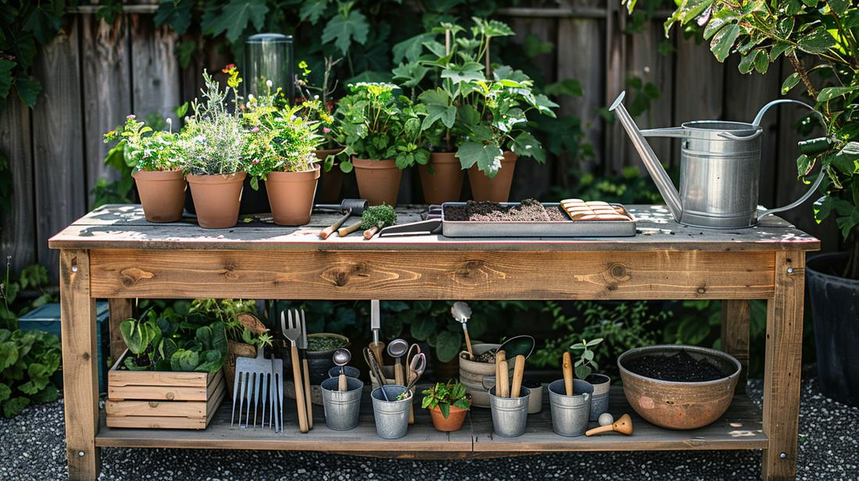
A small backyard can prove surprisingly productive. A few containers of herbs, a raised bed of vegetables, plus a narrow flower border can transform an otherwise unloved corner into a pleasing retreat. The challenge is keeping everything healthy without filling your patio, shed, or storage cupboard with bulky equipment.
To make the most of a limited space, prioritizing the tools you are likely to use becomes important rather than buying a whole set for its own sake. A compact trowel, basic pruning shears, a watering can, a hand cultivator, and a few other essentials can tackle a surprising number of everyday jobs without using up much room.
Essential Gardening Tools for Small Outdoor Spaces
1. Hand Trowel: Your Workhorse for Planting
If you have flowers, herbs, or vegetables to plant in your small backyard, a hand trowel is likely to prove a well-used companion. The narrow blade makes it simple to dig holes, move potting mix, and transfer seedlings without disturbing nearby plants.
A full-sized shovel can prove unwieldy in a confined space or when working around pots or a raised bed. A hand trowel offers better control over such tasks.
Look for items with a durable metal blade, a comfortable handle, and a balanced feel when filled with garden soil. Some tools need to be looked after carefully to prevent rusting, so stainless steel is a good choice if available.
Best for: Planting seedlings, filling pots, moving compost, and filling bare spots.
Find hand trowels on Amazon.com
2. Pruning Shears: Keeping Plants Trimmed and Healthy
Flowers, herbs, and shrubs tend to get overcrowded in a small backyard. Plants often spread into neighboring pots or the ground, flowering plants produce unwanted stems, and shrubs generally require regular shaping. Pruning shears allow you to cut back unwanted shoots without having to bring out larger equipment.
Bypass pruners are generally best for cutting through green stems, while anvil pruners can prove useful for some dry stems and twigs. Always check the recommended cutting capacity rather than assuming the tool will cut through everything.
Lightweight shears are generally advisable for small backyards, along with a locking mechanism and comfortable handles. Keep blades clean and don’t attempt to cut thick stems with unsuitable tools. If there is a need to cut thick, strong branches, choose a different type of equipment.
Best for: Keeping herbs trimmed, removing dead flowering stems, trimming plants, and cutting suitable stems.
Find garden pruning shears on Amazon.com
3. Hand Cultivator: Breaking Up Compacted Soil
The potting mix or topsoil in pots and raised beds can become compacted after repeated watering. A hand cultivator can break up the surface layer, loosen the soil, and work around plants where a bigger tool would be unwieldy.
Three-pronged cultivators are generally ideal for this type of routine maintenance. Some tools combine a cultivator and a small hoe, reducing the number of items required to maintain a small backyard.
Go easy when working around plant roots and avoid deep cultivation around closely planted species, as it can damage their roots.
Best for: Loosening the top layer of potting mix or soil, preparing small areas for planting, and removing small weeds.
Find hand cultivators on Amazon.com
4. Narrow-Spout Watering Can: Watering Containers Without Waste
Even small gardens can become a logistical challenge when watering plants, especially when pots are crowded together or there is a narrow path to work with. A watering can with a narrow spout allows you to direct water toward plant roots without wetting leaves, paving, or nearby furniture.
The size of the can is also important, as too large a capacity will result in unnecessary lifting. Look at the number of containers to be watered and decide on a reasonable size, bearing in mind that the can will need to be lifted to get water to the root zone.
If you have many seedlings or delicate plants, a can with a removable rose that provides a fine spray is a useful buy. However, a hose may prove faster in some cases, especially where containers are crowded together. A watering can is generally simpler to use with small raised beds or where plants are close together.
Best for: Watering containers, seedlings, herbs, and small raised beds.
Find narrow-spout watering cans on Amazon.com
5. Hand Weeder: Removing Unwanted Weeds
Weeds can be particularly troublesome in a small backyard because they compete with your plants for water, nutrients, and space. Weeds with deep roots can be difficult to remove manually, but a dedicated hand weeder can help loosen roots that seem impossible to remove.
Look for tools with a design that allows you to work close to desirable plants without disturbing their roots. A narrow, sturdy tip is particularly useful for working in pots and closely planted beds.
Remove weeds as soon as possible and never allow them to go to seed. If you can’t identify a plant, take the time to research it before attempting to remove it or apply any treatment.
Best for: Weeding small flower beds, containers, borders, and individual weeds.
Find hand weeders on Amazon.com
6. Compact Garden Rake: Clearing Leaves and Debris
A leaf rake can prove unwieldy when working over a narrow row of plants. A hand rake is generally easier to use around pots, raised beds, and low-growing plants.
Use it to clear away leaves and debris. A small rake can also be used to spread a thin layer of mulch over an accessible area, as long as care is taken to keep plant stems clear.
Look for a comfortable grip and suitable tines for the task at hand. Flexible tines are useful for collecting small, light debris, while more robust tines are often required for some types of soil preparation.
You don’t need a powered leaf blower for every small task. In a small backyard, a hand rake often proves faster to take out, use, and put away.
Best for: Cleaning up leaves and other small debris, and preparing small beds.
Find compact garden rakes on Amazon.com
7. Garden Gloves: Protecting Your Hands
Even a tiny garden can produce thorns, rough stems, sharp edges, and abrasive soil that can irritate the skin. A comfortable pair of gardening gloves can make routine tasks much more pleasant by reducing the chance of blisters and scratches.
The type of gloves will depend on the plants you grow. A lightweight pair offers flexibility when planting seeds and small seedlings, while something heavier and more durable is ideal for pruning thorny bushes and moving rough materials.
A good fit is essential. Never choose loose gloves for delicate tasks, while something too tight can cause discomfort during longer jobs.
Keep your gloves dry between uses and replace them when the protective coating or fibers start to wear.
Best for: Planting, weeding, and other routine gardening tasks.
Find gardening gloves on Amazon.com
8. Soil Scoop and Potting Tray: Making Repotting Easier
If most of the plants in your backyard are in pots, transferring potting mix may create more mess than the plants themselves. A soil scoop makes it easier to transfer growing medium from a bag to a pot without using your hands or a large shovel.
A potting tray allows you to work with a contained quantity of soil, fill pots, and separate seedlings. When the task is complete, any unused growing medium can be collected and the tray cleaned before being put away.
Choose a scoop with a comfortable grip and one that is large enough to move a good quantity of soil without becoming unwieldy. A lightweight, washable tray is particularly useful if you are working on a patio or paved surface.
These items are not essential, but they often make regular tasks much neater.
Best for: Filling pots, repotting houseplants, starting seeds, and mixing small quantities of potting mix.
Find garden soil scoops on Amazon.com
Find potting trays on Amazon.com
9. Folding Pruning Saw: Cutting Tough Branches
Some small backyards include older shrubs or small trees that may occasionally require more than a pair of pruning shears. A folding pruning saw can help cut through thicker branches that exceed the cutting capacity of pruners.
Its folding design makes it much easier to store, and a blade cover or locking mechanism can simplify handling.
This is not an essential item for many people, as most small yards can manage without one. If your backyard is planted with herbs, annual flowers, and potted plants, you may never need it. However, for some gardeners, it can become a useful addition to their pruning equipment.
Always check the recommended cutting capacity and use safe pruning practices, particularly when cutting branches that are out of reach. Larger or overhead branches are best left to professional pruning services.
Best for: Cutting thick woody branches and maintaining established shrubs.
Find folding pruning saws on Amazon.com
10. Compact Storage Caddy: Keeping Tools Handy
Tools are much more useful when they are within easy reach. Leaving them scattered around a patio or tucked away in separate cupboards takes up space in a small backyard.
A compact garden caddy, handled tool tote, or wall organizer can help you keep regularly used tools together. Small items such as your trowel, cultivator, pruners, and gloves can be collected in one place, with larger items stored separately.
Never buy a storage system that doesn’t fit the available space. A narrow wall rack or small waterproof storage box may be much more useful than a large cabinet if you are working with a small backyard.
Clean soil from tools before putting them away and keep sharp tools in a safe location.
Best for: Storing small collections of tools and making regular backyard tasks faster.
Find garden tool storage caddies on Amazon.com
How to Choose the Right Tools for Your Backyard
Not every small backyard requires the same type of equipment. A space devoted to containers has quite different requirements from a yard with a small lawn, a vegetable bed, or established shrubs.
Use your garden layout as a guide when choosing the tools you need.
| Your Garden Setup | Tools Worth Prioritizing |
|---|---|
| Mostly pots and containers | Hand trowel, watering can, pruning shears |
| Raised vegetable beds | Hand cultivator, trowel, hand weeder, gloves |
| Flower borders and shrubs | Pruning shears, hand rake, hand weeder |
| Patio with frequent repotting | Soil scoop, potting tray, watering can |
| Small yard with established woody plants | Pruning shears and, when needed, a suitable pruning saw |
Begin with the tasks you regularly perform rather than buying a whole set simply because it comes with more items. A few durable tools with comfortable handles will often prove more useful than large sets that are rarely used.
Smart Ways to Save Space in a Small Garden
Look for multipurpose equipment. A combination hoe and cultivator or a cultivator with interchangeable attachments can often replace several individual tools, as long as the attachments are suitable for the tasks at hand.
Store tools vertically where possible. Wall hooks and narrow racks can help free up much-needed floor space in a shed or utility room.
Avoid oversized equipment. Choose items that are suitable for the size of your plants, containers, and working area. Tools that are difficult to use will often gather dust.
Buy special-purpose equipment when a need emerges. You will not always need a pruning saw, soil scoop, or advanced watering system.
Maintain your equipment. Clean tools after use and keep metal parts dry during storage. Follow the manufacturer’s instructions for sharpening blades and maintaining other tools. The right care can greatly extend the life of your equipment.
Final Thoughts
A small backyard doesn’t require a large set of tools. The right combination of a hand trowel, pruning shears, cultivator, watering can, and gloves can tackle a surprisingly wide range of backyard tasks. A hand rake, weeder, or potting tray can make specific jobs much easier, while specialized equipment can wait until it becomes necessary.
Amazon Affiliate Disclosure: As an Amazon Associate I earn from qualifying purchases. This article contains affiliate links, which means we may earn a commission if you purchase through qualifying links, at no additional cost to you.